When was the last time you looked up in a reliable source the definition of a genealogy word whose meaning you think you know reasonably well? Did you learn something? Were you really correct? If you thought the definition was wrong, did you do more work to determine if the definition really was incorrect? Did it turn out that you were wrong? Occasionally I look up the definition for words that I think I know. I always look up ones that I don’t–especially if they are words used in any record I’m analyzing for my genealogy. I may not necessarily be able to recall every definition precisely later, but I will have learned something. And the more I know about terminology, the less likely I am to interpret […]
Don’t press a family member who cannot remember a specific detail you would just love to know. Getting in someone’s face when their memory is rusty does nothing to cause them to remember the information more accurately. It only serves to frustrate the other person, to increase the chance they remember fewer pieces of information, and to tell you to leave and not come back. Your goal when asking questions is to elicit as many memories from the person as you can, record those memories, and engage the individual in a way to encourage them to remember more. Many times, talking about something else will cause the person to remember more about that event they “couldn’t quite recall” a few minutes before. It’s not really important if they […]
If your relative died of any sort of contagious disease, check local newspapers for any mention of an outbreak. The death certificate should list the cause of death, but it won’t indicate whether it was an isolated incident or if there were others. The outbreak may be mentioned in the local newspaper–even if your ancestor is not named specifically. Newspapers can be a great way to learn about your relative even if her name is not specifically mentioned. The Warsaw, Illinois, newspaper referenced a case of Smallpox in Stillwell, Illinois, in 1902.
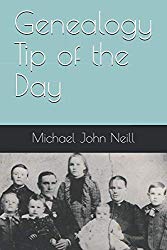
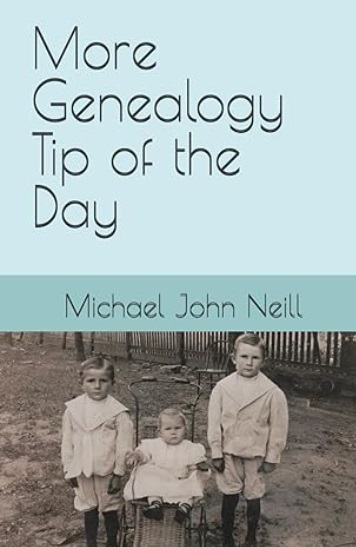
If Amazon’s too slow, we still have copies of the Genealogy Tip of the Daybook that can be sent directly to you via USPS. It can be a great way to refresh yourself on things you forgot, learn new things, or view research from a different perspective. It can be read in one setting, browsed at random, or used to generate ideas for your own research. It’s easy to read, informative, and geared towards helping you with your research and not seeing how much labored prose and ten-syllable words can be used in one sentence. If you’re “stuck at home” (or even if you are not), get your copy today! There’s more information on the book on our website.
There’s a small town in the county where I grew up that had a newspaper from the 1850s through the latter part of the 20th century. It’s a good fifteen miles from the town where my grandmother grew up and even further from where my grandmother raised her family after her marriage. My grandmother never lived in the town herself although her mother did for approximately fifteen years. Grandma’s sister lived there for approximately twenty years as well. There are numerous references to my grandmother and her family in the gossip columns of that newspaper. Some of those are in connection to her mother, some to her sister, and some because Grandma attended family events “within shoutin’ distance” of the town where the newspaper was published. Get our […]
I make “zoomed in” images of records all the time, particularly if I am taking pictures of a record that I can only access in paper format. Images of this type can facilitate analysis and interpretation. They can also facilitate confusion if they are not identified and organized. The illustration for this post was from an 1845 state census record for the state of Michigan. Somehow it became separated from the other pictures I took of the same record. Make certain as you make images that they are organized and identifiable. The time to do that is when you create the images, not afterwards. And always get an overall picture of the image–even if you can’t read it all that well. Perspective matters.
Around 1902, widow Nancy Rampley hired a young neighbor man to help with the farm work during the busy time of the year. According to her widow’s pension application, she also provided him with board in addition to a monthly. In 1903 the hired man was her son-in-law. Several of my immigrant families in the 1880 census have a “hired man” who, upon further research, was discovered to be a relative of the wife or husband in the family. The relationship was not stated in the census. Some immigrants, if their financial situation warranted, would have hired help, someone unrelated who was from their same area of origin who they wanted to help after they “crossed the pond.” Sometimes the hired help was simply an unrelated neighbor who […]
In the 1910 census a relative and his wife are a recently married couple with an infant child. By 1920 that same relative is living in another state with another wife. The short version of the story is that the couple divorced and each had married other individuals by 1920. The 1910 child (a boy) was raised by the mother and her second husband as their child used that second husband’s name throughout his life. DNA matches confirmed the relationship as descendants of that 1910 child have done DNA tests and they match me at a level consistent with the relationship. Is it possible that your relative had a short term relationship that resulted in a child or two and after the relationship ended it was never talked […]
It’s hard to think of something new every day, so for today we’ll mention a few things that are worth always keeping handy in your genealogy toolkit: Do not jump to conclusions. Look at all the information–not just what excites you or agrees with your “hoped for” conclusion. Research to find what you can–not to prove what you think you already know. Most tall tales have a grain of truth to them. Do not research based on memory–double check the facts that “came from your head.” Everyone makes mistakes. Don’t be afraid to revise an incorrect conclusion. Kickstart your genealogy research!Get your own copy of our book: Genealogy Tip of the Day
As soon as I saw the reference in the naturalization record from the early 20th century I knew it was not spelled correctly. The name of the town in northern Germany was probably not Fresse. I didn’t start to research the European ancestors of this relative born in “Fresse,” until I had done significantly more work on him in the area of the United States where he settled. This was done to potentially learn more about him here and to get other spellings for that place of birth–the mysterious “Fresse.” It was actually Wrisse. It would take some research to finally prove it. An unproven hunch is still an unproven hunch. Unproven hunches can lead to research ideas and to records that may eventually lead to hunches that […]
It was disappointing that the envelope was empty and I suspect it was saved for the stamp and the postmark. Upon posting it to the Facebook page for Genealogy Tip of the Day, a fan mentioned a Chilean earthquake that resulted in a tsunami that reached the Hawaiian Islands and she suggested that maybe the letter contained news of the impact on the islands. The details she provided made it easier for me to find online references to the earthquake and the damage. That was a history lesson for me. It was not even necessary to know about the incident to find out about it on a Google search. Entering “Hawaii May 1960” was all it took to discover websites that referenced the event. Do you Google dates […]
Despite lamentations to the contrary, the US Census is not taken to be a genealogical document. It is taken for a variety of governmental purposes and the data it contains is used by a host of governmental and private agencies. It is not meant to provide a genealogical record for future generations. No census was ever taken as a means of providing a genealogical record for the future. Public records may provide information of use to genealogists, but those records were created for other reasons. That information was asked for other reasons. Military records, land records, pension records, court records, probate materials, and other records generated by a government body were not created to leave a genealogical record. The census was not either. Instead of lamenting the details […]
Digital indexes to digitized records often take the searcher to the exact page where the searched for name is mentioned. Don’t assume that’s it. There could possibly be more. The “entry” for the person of interest could extend over multiple pages in the original ledger or record and those multiple pages could have been digitized separately. Information about the person of interest may be contained in subsequent images even though the person’s name was not on those images (and hence not indexed). When browsing actual records onsite or images online, make certain you keep going until you get to the next actual record. It may take several pages or images before that is done. Get your own copy of our book:Genealogy Tip of the Day
The name on the back of the photograph might not be of the individuals pictured on the reverse side. It could be the person to whom the photograph was to be given. My great-grandmother had several photographs of her son’s wedding that took place in Chicago, Illinois, in the 1950s. Every one of them had “Mom” written on the back. Some of them had “Mom U,” apparently indicated “Mother Ufkes.” A few of them did not. “Mom Ufkes” was in a few of the photographs, but not many. Since I had several of these pictures, the intent was easy to discern. But what if I had only had one of these pictures my great-grandmother had of her son’s wedding? I would have had no comparison and would have […]
You’ve seen the headlines or article titles online that are misleading or highly inaccurate. They tend to be similar to articles such as “Grandma Finds Shocking Surprise in Medical File Ten Years in Making” and it turns out she left a box of insurance claims in the closet where the ten-year old cat has started napping. While titles of genealogy databases are not quite that extreme, they can suggest that the database includes regions or time periods that it does not. Make certain that the database of Oklahoma marriages between 1900 and 1925 includes the county and time period that you need. Make certain that set of digital images of newspapers includes all issues during the time frame in which you are searching and not just images of […]



Recent Comments