Change for the sake of change is just change. Change with a purpose is a separate matter entirely. What new skill have you learned to help you with your genealogical research? Is there a software program that might help you to organize your genealogical information? Do you know as much about legal terminology as you should? Are you familiar enough with land descriptions to interpret them reasonably well (particularly helpful if your ancestors were landowning farmers)? Do you know how to make charts and tables in your word processor well enough so that you can use them to organize pieces of information that are confusing? Don’t be afraid to learn something new. It may help you with more than just your research.
There’s a grade school picture of my Dad where his hair is a bright blond. That’s certainly not the way I remember it. As long as I can remember it was black. When researching your relative ask yourself: what about them could have changed over time? It could have been more than their hair color. It could have been their occupation, their marital status, their economic status, their religion, etc. Those changes could explain why they cannot be located in certain records, in a certain place, etc. Some changes are obvious. Others are not. Depending upon how many of those changes we have had in our own lives it may be easier to see how similar ones could have impacted our relatives. If we’ve not experienced those changes, […]
Anything can be anywhere. This picture of my grandmother and her sister, taken in the 1920s and probably less than two inches on a side, was found tucked in the bottom drawer of my mother’s jewelry box. I nearly overlooked it. All of Mom’s pictures were grouped together with other pictures. This one was all by itself. The girl on the right in the picture was my Mom’s mother-in-law. Fortunately I know who the girls are, but I have no idea where Mom got the picture. I’m not certain how it got in the jewelry box, but it was likely done for safekeeping–either by my Mom or my Dad. The point: anything can be anywhere. This not only applies to family photographs and ephemera, but pieces of information […]
Most of the time when a child has a guardian appointed it means at least one of their parents is deceased and that the minor child had an interest in that parent’s estate that needed to be protected. If the father died, the surviving widow may not have been appointed the guardian. But dead parents were not the only reason a guardian may have been appointed for a child. If another relative died and wanted to leave the child property, they may have indicated who they wanted appointed that child’s guardian upon the relative’s death. Sometimes that guardian was not the child’s parent. The most frequent situation of a child with living parents being appointed a guardian is when a grandparent was not overly fond or trusting of […]
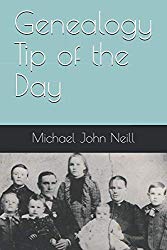
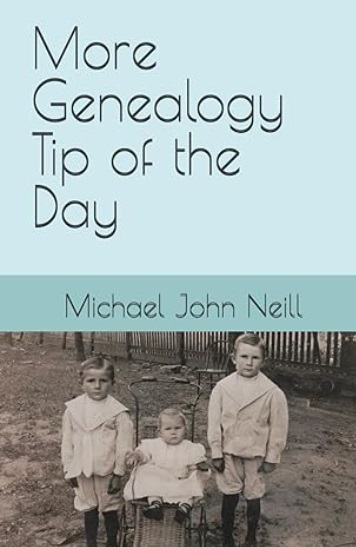
It’s available! Genealogy can be confusing and sometimes what the family historian needs is something short and to-the-point that can help them get their research back on track. That’s the intent of “Genealogy Tip of the Day.” Long-time genealogist Michael John Neill uses his thirty years of research experience to remind readers of things they had forgotten, make them aware of things they did not know, and encourage them to increase their research and analytical skills. This is not a typical how-to book that has a chapter for each content topic. Topics are spread throughout the book. Tips are based on actual research, actual families, and actual problems. Each day’s tip is meant to be a relatively short read, is engaging, accurate, and occasionally funny. Tip of the […]
The picture discussed in this post is not included because the other two individuals are living. There’s a picture of me in a suit taken in the early 1970s. I look to be approximately four-years old. When it was taken was a mystery. There’s a little girl, also dressed up and also about my age, standing next to me. I have no female first cousins, so that’s not who the person is. I did not recognize the person and she didn’t appear to be any female relative I could think of based on her age, hair color, and general face shape. She’s not a relative. As soon as I looked in the background of the picture and saw the woman sitting in the background in a church pew, […]
A little reminder about those DNA matches and other relatives (and potential relatives) who do not respond to your queries, emails, and messages. Sometimes life intervenes and genealogy needs to take a back seat. Other people do refuse to respond, are unable to retrieve messages, accidentally delete them, etc. But that distant cousin you communicated with may just have other things going on in their life that have to take priority.
The memories of the long dead people who provided information on a 1900-era death certificate can easily be wrong. So can yours. What things about your ancestors are you using to help you research that might not be true or which you are remembering incorrectly? Are you searching the 1860 census for a relative who died in 1857? Are you looking for an obituary in the 1890s for someone who died in 1902? Virtually any detail can be remembered incorrectly. What details are you pulling from your head when you should be pulling them from your files?
When searching digital images of newspapers, we often don’t think of small children as being named specifically. While children are not named as often as adults, they can be mentioned. Instances that come to mind are: attendance at family reunions, appearance in weddings, survivors in obituaries. Children are not always mentioned in situations such as these, but some times they are.
Sometimes writing up genealogical proof can seem overwhelming. It does not have to be. If writing something regarding a family living in the 18th century seems like too large of a task, then start small. Dating pictures–and including your reasons–can be a good way to start writing up genealogical analysis at a rudimentary level and getting your feet wet. This picture of my Dad, my brother, and I was probably taken in April of 1974. My reasons for this can be stated simply: The picture is stamped “Jul 1974.” This is a development date. My brother and I appear to be ages consistent with a 1974 photograph date (years of birth not included in this blog post–they would be in an actual blog post). The picture contains a […]
If your ancestors lived in public land states and owned real property, are you familiar with sections, quarter sections, townships, etc.? If not, you could be interpreting a property description incorrectly or missing out on a crucial detail. Theoretically, a: a township is a square six miles on a side; section is a mile on a side and contains 640 acres; a quarter section is a half of a mile on a side and contains 160 acres. There are exceptions to these dimensions and acreages that usually result from geography and political boundaries. For more about these methods of description and units of measure, refer to this reference guide.
To learn more about your ancestor’s employer as given in a city directory, search the rest of the city directory as it may include advertisements or list the employer in a list of area businesses. Consider performing a Google search for the name of the business and search local and regional histories as well, many of which have been digitized at Google Books (http://books.google.com) or Archive.org (http://www.archive.org).
Many records used in genealogical research were created as a part of a larger process or flow or information and records. When analyzing a document or working to understand it, determine what that process was. It’s also helpful to understand what function the document or record served in that process. Birth certificates were to document a birth, but summaries of information from those records may have been used for a variety of governmental purposes. The specific details of what was on the record may have been used by the individual to document their age, their parentage, etc. Death certificates are used to document a death, but different pieces of information from that record are used by different individuals for a variety of reasons: compilation of cause of death […]
If your ancestor had a first, middle, and last name, keep in mind that it is possible that those names could be in the wrong order in a record. If the names are in the wrong order on the record, then the ancestor will appear in the index under the wrong “last name.” If the index does not include the last name of interest, consider searching for that relative with their first or middle name as their last name.
When using a search option at an online database, do you know how that site implements wildcard searches, Soundex searches, and other search options? Getting creative with search terms is often necessary, but if you don’t know how they are really working, you are not being effective. Experiment and look at your results and see if you are getting what you think you should. A Soundex search for the last name Smut on a site with English language last names should result in a large number of hits. And if you don’t know why, then review what Soundex really is.




Recent Comments