If you had an aunt or an uncle who was divorced, have you considered looking at their divorce records? These records are typically local court records and there may be some restrictions in accessing them in some locations, but they are generally public records–at least the generic details. In earlier times state or colonial legislatures may have granted divorces. In cases that were heard by a local court there may be a court packet containing testimony and affidavits. There may be mention in those records of where they married or where they lived when they were first married—details that can help with determining where your direct-line ancestor was from. And there is always the chance that your ancestor provided testimony in the divorce of a sibling. These records […]
While some relatives take their family history stories to their grave, others become more willing to tell stories as they age. The reasons for changing their mind really do not matter, but remain open to the possibility that Aunt Martha may eventually decide that the world will not end if she tells you that “family secret.” Or course some people are not going to tell you things no matter what. But some do become more open with age. It may be worth a try.
Genealogists do a great deal of work digitally. The plethora of digital images of records certainly has made research easier than it was in the past–both in terms of accessing records, sharing them, and storing them. But there still may be times (at least for me) where using paper makes it easier to understand things, “lay things out,” or otherwise help with visualization. It’s not just official records, relationship charts, and other charts that I sometimes like to use in paper form. Maps are another research tool that I sometimes like to print out and mark up with additional information–location of key events or key places. I have digital copies of these maps without my markings, but sometimes marking things on a piece of paper helps me to […]
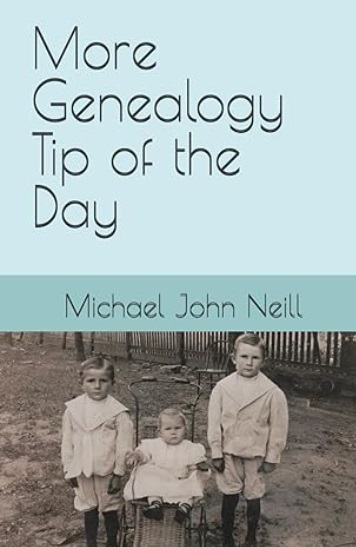
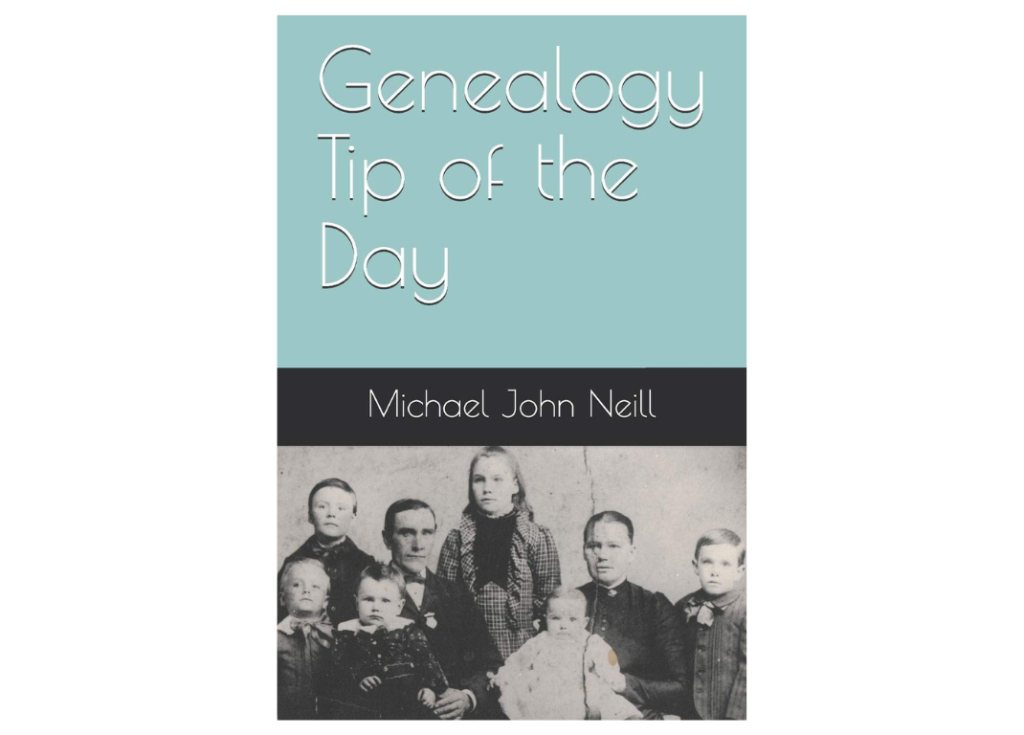
I shared a picture of the cover of the upcoming second Genealogy Tip of the Day book and a cousin of mine commented on the picture I used to illustrate the front of it. I already knew who was in the picture and where it was taken. But a cousin of mine told me a few things about the picture that I did not know–the situation under which it was taken and my great-grandmother’s reaction to it. It reminded me that even when a picture has been identified, there could still be work to be done. Others may have additional memories of the photograph or be able to tell you more about it besides who is in it. Those details may be genealogically relevant as well. Personally it’s […]
If you have a newspaper clipping that is undated and unsourced, flip it over. Anything can be a potential clue as to location or date, even classified ads. One obit I found in a set of clippings had a date, but no name of the newspaper. Flipping it over I found the classified ads. The phone numbers and street names suggested it was from a nearby town of 40,000 and not one of the small towns near where the relative actually died. Accessing newspapers from that town allowed me to locate the digital image of the newspaper with the same obituary I had in the clipping.
I know cemetery photographs can be tagged with GPS coordinates, but there are times when a picture just makes it easier to find a stone again or indicate to someone where it is. This photograph was one of several taken at the Lutheran Cemetery in Peoria, Peoria County, Illinois, to give an idea of where the stone of interest was located. I should have indicated in the image what road I was standing on as well. Closeups of stones are great, but perspective helps. In addition to background shots, take photos of adjacent stones and a picture showing the relative position of those stones to the stone of interest. Genealogy Tip of the Day book number two is in the final stages. You can add yourself to the mailing […]
When searching for records of an estate settlement, keep in mind that it may be ten or twenty years before an estate is finally settled. This final settlement may appear in the probate records or the land records–or both. Thomas Sledd died in Bourbon County, Kentucky, in 1815. His land was finally partitioned among his heirs in 1831. Genealogy Tip of the Day book number two is in the final stages. You can add yourself to the mailing list for announcements about the book when it’s available–including a pre-publication order and price option!
If you have a sample of a relative’s known handwriting, do you save an image of it along with records and documents? Years later, someone may be glad you saved that sample. Census records and other materials are easy to find elsewhere (usually), but unique items such as handwriting samples are not. Consider saving those images along with record images related to your ancestor. This 1829 consent to marry for William A. Thomas was witnessed in 1829 by my ancestor Augusta Newman. I’m reasonably certain he wrote it–so I’m attaching it to my images for him in my genealogical database. Tip book number two is in the final stages. You can add yourself to the mailing list for announcements about the book when it’s available–including a pre-publication order […]
Years ago, I discovered that my grandmother had a step-grandmother who had never been mentioned. For a long list of reasons, I never mentioned the step-grandmother to my own grandmother. However, I did learn where the step-grandmother was buried. A few months later, my Dad and I had cause to go close to the cemetery on a trip somewhere else and I asked if we could stop for a few minutes to see if I could find the stone. There was no stone. Dad mentioned to Grandma the next morning that we had stopped at said cemetery. Grandma later very directly asked me WHO I was looking for in THAT cemetery. Grandma probably knew who I was looking for as there are NO other family members buried there. […]
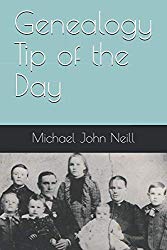
I’m in the final throes of editing and proofing the second (and last) Genealogy Tip of the Day book. It’s been a fun project and we’ll continue the blog here, but there won’t be any more tip books as I want to work on other writing projects. You can add yourself to the mailing list for announcements about the book when it’s available–including a pre-publication order and price option!
Normally an ancestor has to be dead to have an estate settlement, has to be born to have a birth certificate, etc. Think about what really HAS to be when you research your ancestor. He didn’t have to get married to reproduce. He didn’t have to name his oldest son after his father. He didn’t have to get married near where his first child was born. He didn’t have to have a relative witness every document wrote. He didn’t have to be buried in the same cemetery as his wife. She didn’t have to live with her parents as a child. There are few “have tos” in genealogy. Make certain you aren’t using “have tos” to make brick walls for yourself.
Don’t expect greater accuracy from records than you are capable of yourself. Your ancestors were just as human as you are and the information they gave is subject to the same memory challenges that you may have.
This publication by John J. Newman was published in 1985 by the Indiana Historical Society and has been published on the Society’s website. Please observe the usage limitations noted on the Society’s website under the “use statement.”
I’m in the final stages of editing the second Genealogical Tip of the Day book. In some ways it is a journal of various individuals and families I have worked on while writing Genealogy Tip of the Day. While editing, I find myself making notes to follow up on leads and discoveries that I used for a tip of the day and then promptly forgot about. Have you thought about keeping a brief journal or diary of your genealogical discoveries? Might be interesting to review a few years down the road.
Stuck? Put aside everything you have on an ancestor and “recollect” your information on him. It’s not necessary or practical to throw out what you have found and “start over.” It’s just helpful to review each document you have and contemplate what that document really says (and does not say). It may be helpful to create a whole new database entry for this ancestor and re-enter the paper material you hae and then try and relocate the data you found in online digitized records. Think carefully about every assumption you have made and every step in your logic and reasoning. Perhaps starting over (or pretending to) is what you need to do to get over that brick wall.



Recent Comments